
The Capacity Threshold
When life asks more than you can give, and what it takes to manage it.
 · 8 min read
Ten years of coaching have shown me one pattern that does more damage than any other, at work and at home.
The widening gap between what life asks of us and what we have left to give, and our habit of trying to close it by doing more.
And most of us don’t notice until it has already cost us far more than we’d like to admit. I know it from my own life too.
Having built three companies of my own, and faced my fair share of challenges along the way, I’ve paid that price more than once, and it’s probably why I care about it so much.
If your life is, or starting to, ask more of you than it used to, here’s what I’ve learned about managing it.
The strategy that built your life
It usually begins when life starts asking for more. Sometimes this happens gradually, as the business or a role grows and responsibilities pile up. And sometimes suddenly, when a child is born, or a partner or parent falls ill. Often, it’s both.
Either way, there’s more to carry, with more people depending on us and more to keep track of.
Most of us respond by doing more. It’s how we got to where we are, and until a certain point it works. We keep everything running the way we always have, and because we’re still delivering, it doesn’t really feel like anything’s wrong.
At least that’s what we tell ourselves.
But as we try to keep up, our capacity, the energy and attention we have available, doesn’t grow with the demands. If anything, it starts to shrink. And at some point, we cross the line where life starts asking more of us than we can give.
That line is what I call the capacity threshold.
The line you don’t see coming
To put this into context, I often use a simple model to show what happens to our capacity as the demands of our lives change.
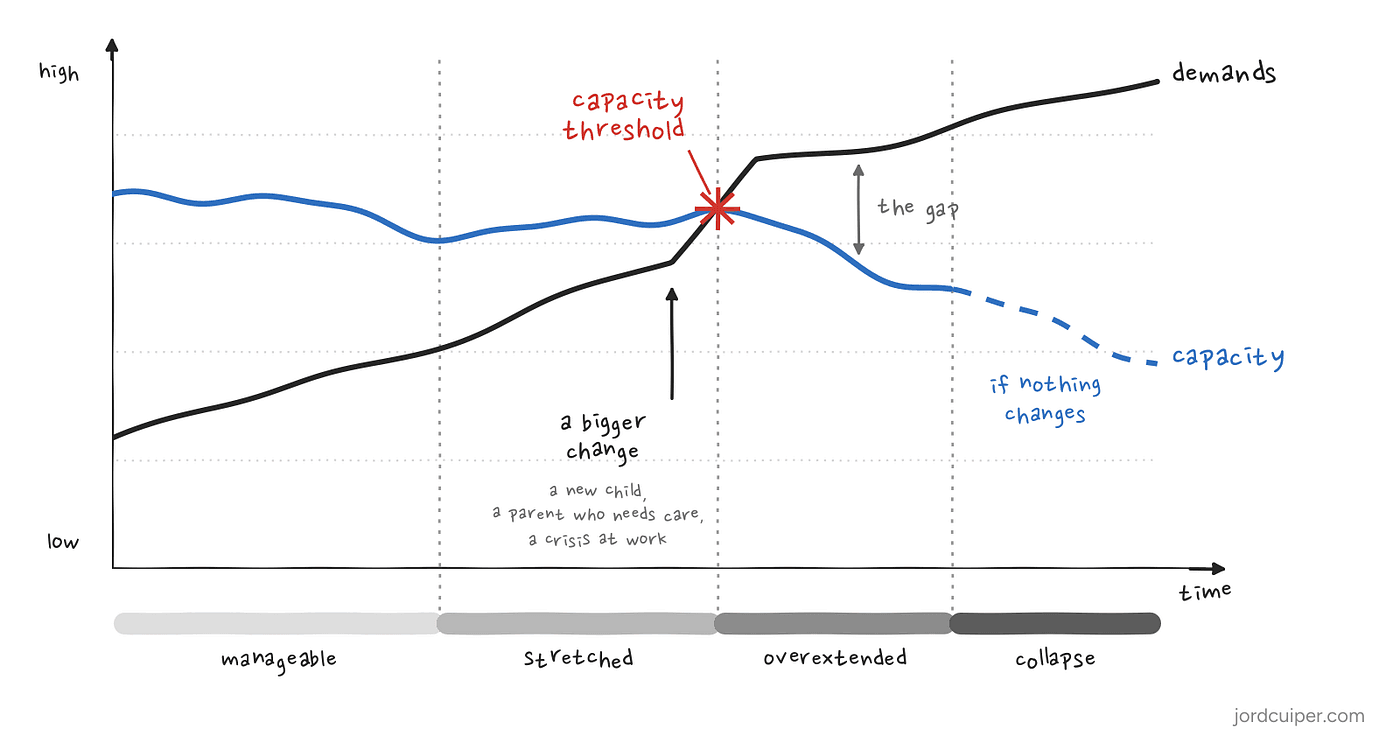
In this example, you see one of the most common patterns I come across, where our responsibilities grow steadily over a few years, until a bigger change, like a new child, a parent who needs care or a crisis at work, makes them jump almost overnight.
In those first years, we’re still in the manageable zone. Each new responsibility feels fine on its own, and we take it on without much thought.
What we don’t notice is that the space between the two lines is shrinking, and more of our day goes to reacting to whatever comes up first. As that space disappears, we move into the stretched zone, feeling busy all the time, and somehow always behind.
Then the bigger change arrives, and demands shoot past what we can give.
To keep up, we start borrowing from the activities and moments that help us recover, as well as from the time with the people closest to us. We move from feeling stretched to being overextended, and, in an attempt to cope, we fall back on what we know best.
However, the longer we spend on the wrong side of our threshold, the harder it becomes to think, prioritise and execute, which only widens the gap. The very approach that used to help us get things done now makes doing those things harder.
Of course, this is only one version. It can also arrive as two big changes within a few months of each other, or as a busy period that was meant to be temporary and quietly became the norm.
Whatever form it takes, learning to recognise your capacity threshold, and how to respond when you reach it, can make the difference between being able to hold and shape the life you’re building, and finding yourself overwhelmed by one you can barely keep up with.
Life on the wrong side of the line
The first signs I tend to see are small, and easy to dismiss. People tend to forget things they’d normally remember, postpone decisions they need to make, have less patience with the people around them, and feel tired in a way that sleep doesn’t fix.
Many wake up in the middle of the night with their mind already working through everything they need to do, solve or fix. And without really noticing, they start leaning more and more on coffee during the day, a glass of wine in the evening, or anything that gets them through.
For some, it eventually turns into the opposite. Things stop landing at all, and they start feeling flat and distant from their work and the people they love. The problem is that it happens gradually, which is exactly why it’s so easily missed.
And the longer it goes on, the harder it gets to see. Prolonged stress makes it harder to think clearly and regulate our emotions, which also makes it harder to step back and notice how far we’ve drifted.
When we struggle to cope, most of us conclude that something is wrong with us. Personally, I’ve come to believe that much of what we take as proof of that is simply what happens when we’ve lived on the wrong side of this line for too long. Viktor Frankl, the psychiatrist who survived the Holocaust, put it this way in his book Man’s Search for Meaning.
“An abnormal reaction to an abnormal situation is normal behaviour.”
His circumstances were far more extreme, but the principle holds.
That said, stress is rarely the whole story. We differ in how vulnerable we are, and some conditions have very different roots. But it’s always worth asking how long we’ve been carrying more than we can hold.
Because even though much of the ‘damage’ is reversible, for those who reach the point of exhaustion, or collapse, the way back can take years.
Hitting the invisible ceiling
Once we’ve been past the line for a while, it starts to feel as if we’ve hit a ceiling. However hard we work or try, it’s never quite enough, and because the demands aren’t going to decrease, it becomes difficult to see how that will change.
Over time, this shapes what we believe we’re capable of, and what we think is possible for our future. We may still want to take on the bigger role, start our own business or have a family, but when we’re already struggling to manage what we have, it’s hard to imagine how we could carry more.
Once we accept that doing more has stopped working, most of us turn to one of two answers, and both are being sold to us every day.
The first is to optimise. We work on our sleep, recovery or whatever protocol promises a little more energy. And it can help. But past the line, recovery can’t keep up with demands that keep exceeding what we can give, and at some point no amount of optimising will close the gap.
The second is to step back. We lower our ambitions, turn down the bigger role or put off a family, or change course entirely to build a life around freedom, flexibility and fewer people depending on us.
For some, stepping back is the right choice. Yet I also see more and more people letting go of things they still want because they no longer trust that they could cope with them. They’re mistaking the limit of how they manage their life for the limit of what they can handle.
What both have in common is the assumption that taking on more means being able to do and hold all of it. And as long as we believe that, the only options seem to be to optimise every part of our lives in search of a little more capacity, or step back and settle for less.
Back in the driver’s seat
There is another way, and it starts with how we manage what we already have. Our capacity will always have a limit, but our ability to manage the demands on it can keep developing.
In my work, I approach this much like financial planning. Capacity is a limited resource, just like money, and most of us spend it without a budget.
Reorganising life around the capacity someone actually has means deciding what comes first and what needs to go, and then building the structure that makes those choices hold, routines and a way of planning and following through, so that not every day becomes a new negotiation.
Over time, that becomes an internal filter. Every new task or opportunity gets weighed against their current capacity and priorities before it gets a yes, and taking something on means deciding what will get less.
What makes it hard is what it asks of us. It often means letting some things be less than we’d like, disappointing people who are used to us always being available, and allowing someone else to handle things, even when we could do them better or faster ourselves.
And accepting those choices, without trying to make up for them later.
But once people start making those choices, the first thing I tend to see is relief. Much of what wore them down was everything still open, and once something has a place, the mind can let go of it.
And with that, their energy and attention can go to what actually needs to get done, or what matters most to them. Most of what’s asked of them is still there, but they’re the ones deciding how it fits together, and having a say in it makes the same pressure far easier to carry.
Of course, there will always be stretches that ask more than we can sustain, including ones we never chose. Last year was one of those for me, when several things arrived at once that I couldn’t step back from.
In periods like that, this work matters even more. We decide what needs us most, accept what will get less, let others help, and rebuild what it took once it’s over.
The one thing I’d teach
That’s why, if I could only teach one thing, it would be this. How to recognise when life is asking more than we can give, and how to grow in the way we manage it.
Because one thing is given. If you’re building, leading or raising a family, life will continue to ask more of you. And you can keep trying to hold all of it, or reduce what you take on. Or you can learn to manage it differently.
If you want to start practising this, here are three questions to sit with.
1. Where am I now?
Am I within my capacity, running without margin, or carrying more than I can sustain? And how long has it been this way?
2. Where am I heading?
Is what life asks of me likely to ease, stay the same or keep growing? And is my capacity growing with it, holding steady or being worn down?
3. What do I need to grow into?
What do I need to learn, decide, accept or let go of to manage what life is asking of me?
As always, I hope it helps.
Want to receive my newsletter in your inbox?
Every weekend, I share one practical idea on the challenges and choices that shape how you work, lead and live.
No spam. I’ll never sell your details. Unsubscribe anytime. Privacy policy