
Why conscientiousness is fading, and how to rebuild it.
Over coffee last week, I read new research on a change I’ve been seeing for years. More and more people are losing agency over where their attention goes — being pushed and pulled by whatever is loudest, most urgent, most trending, or most convenient.
For some, that means checking their phone before they have even lifted their head from the pillow. For others, it’s dropping commitments when things get difficult. For many, it’s simply watching hours disappear into digital noise and distraction.
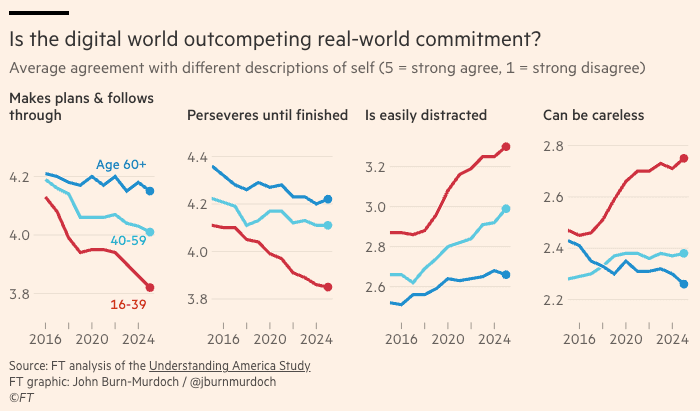
It’s easy to dismiss this as poor self-control, or a lack of motivation, but it’s part of a broader, measurable decline. The latest research now shows that this is happening because one of our most critical life skills is fading out.
It’s a skill called conscientiousness, which comes down to our ability to commit, follow through, and keep showing up.
And this matters far beyond career success.
Studies consistently show it’s one of the strongest predictors we have of long-term outcomes. Of all personality types, conscientiousness not only influences how well you perform, but also how long you live, how strong your relationships are, how well you weather life’s storms and how satisfied you feel.
Which means the opposite is also true.
When conscientiousness declines, health deteriorates, relationships fracture, resilience weakens, and confidence erodes. Without the ability to commit and follow through, you will struggle to weather difficulty, to stay connected, and to trust your own word.
We are already seeing this play out, especially among young adults.
The changes in our environment over the past ten to fifteen years have led to distraction at record highs, commitment and follow-through in decline, anxiety rising sharply, and social connection and sociability falling away.
In fact, research shows that young adults — long the most extroverted group in society — are now the most introverted (let that sink in!).
And this is not going to change anytime soon.
The world we live in is designed to fragment attention and make commitment harder. Smartphones, social media, streaming, and endless notifications all train us to chase what is urgent, easy, or entertaining, while abandoning what is meaningful but requires effort.
The result will be an ever-increasing divide. On one side, lives that become scattered and reactive, pulled in every direction. On the other, the few who can create, commit, lead, and sustain over the long term.
And that gap will only grow bigger over the next 5–10 years.
It’s both sad and shocking, yet it’s also full of opportunity, because the ability to ignore distractions and choose long-term benefits over short-term comfort isn’t just helpful anymore.
It’s becoming the rarest and most necessary skill in the modern world.
The unfair — or perhaps, the fairest — advantage of our time.
Because, unlike intelligence or socio-economic background, conscientiousness can be rebuilt, trained, and strengthened over time.
And for those who are willing to take that responsibility, it becomes the defining strength in work and in life.
This training begins with counter-practices.
Here are four places to start:
- Protect your attention: delete or strictly limit one app that most erodes your focus and stick to it. Create friction so that using it requires intention, not impulse.
- Practise mono-tasking: schedule one hour each day for deep, uninterrupted work, creation or reading. Phone out of reach, no tabs, no notifications.
- Rebuild self-trust: make one small promise to yourself each day and keep it without exception.
- And spend time offline: Step out of the stream. Run, walk, or share a meal without a device nearby. Let yourself remember what it feels like to be fully present. And yes, even bathroom breaks count.
These are just a few of many options. My advice is to think for yourself, get honest, and be radical in your approach.
Because with every choice, you are moving in one of two directions.
Either you erode the very capacity that protects your performance, health, relationships and resilience. Or you grow the one skill that is becoming rarer, and more valuable, with each passing day.
The choice is yours.
As always, I hope it helps.
Your guide,
Jord
Want to receive my newsletter in your inbox?
Every weekend, I share one practical idea on the challenges and choices that shape how you work, lead and live.
No spam. I’ll never sell your details. Unsubscribe anytime. Privacy policy